
New York Courts Move to Ban Smart Glasses Inside Courthouses

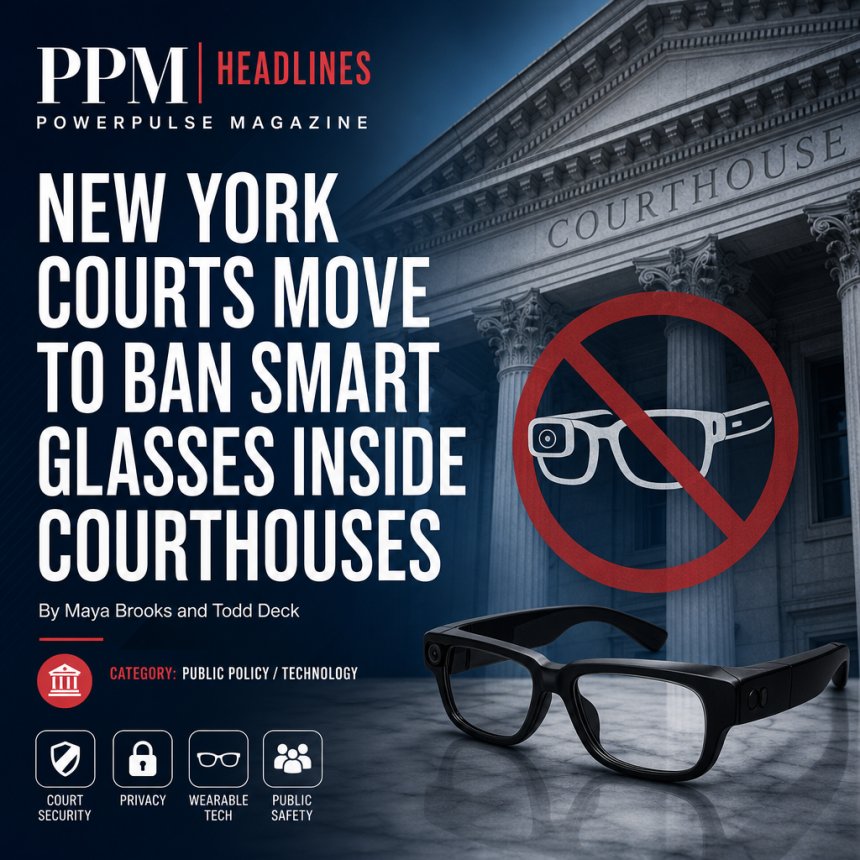

PPM HEADLINES | PowerPulse Magazine
New York Courts Move to Ban Smart Glasses Inside Courthouses
By: Maya Brooks and Todd Deck
Category: Public Policy / Technology
Tags: New York Courts, Smart Glasses, Court Security, Privacy, Wearable Tech, NYC, Legal News, Public Safety
Key Highlights
- New York’s court system has issued a statewide rule barring smart glasses and other recording-capable eyewear inside courthouse facilities.
- The policy takes effect on July 20 and applies across the New York Unified Court System, including New York City courthouses.
- Eyewear or headwear with built-in cameras, microphones, or audio/video recording features is prohibited.
- Prescription smart glasses are included in the ban.
- Visitors and staff must surrender the devices to uniformed court officers for safekeeping before entering.
- The goal is to prevent secret recordings of court proceedings, witnesses, jurors, and other sensitive courtroom activity.
New York is drawing a firm line between convenience technology and courtroom security.
According to the New York State Office of Court Administration, smart glasses and other eyewear equipped with recording capabilities will no longer be allowed inside New York courthouse facilities once the new policy takes effect on July 20. The rule applies statewide across the New York Unified Court System, which includes courthouses in New York City.
The mandate is straightforward: if the glasses can record, capture audio, or take photos or video, they do not stay on your face inside the building. Visitors and staff entering a courthouse with such devices will be required to hand them over to court security for safekeeping while they are inside.
The policy also makes clear that prescription smart glasses are not exempt. In practice, that means the rule is not limited to novelty wearables or consumer tech enthusiasts. It extends to anyone whose eyewear contains built-in recording hardware, regardless of whether the glasses are medically prescribed.
Why the Policy Matters
Courthouses are not ordinary public buildings. They are spaces where privacy, witness protection, jury integrity, and procedural fairness all matter. Even a small, discreet recording device can create major risks if someone captures testimony, sensitive evidence, or jury activity without permission.
That risk is exactly what the court system says it wants to stop.
As smart glasses become more common and more difficult to distinguish from regular eyewear, the enforcement challenge also grows. A policy that once might have focused on obvious cameras now has to account for sleek, everyday-looking devices that can record in ways traditional security screening may not immediately detect.
New York’s answer is a broad restriction: if a wearable can record, it must stay out of the courtroom environment.
What This Means for Visitors and Staff
For anyone planning a courthouse visit, the immediate takeaway is simple: do not wear recording-enabled smart glasses to court if you want to avoid delays or surrendering them at security.
Here’s what to expect:
- Leave smart glasses at home if possible.
- If you rely on prescription smart glasses, bring a regular backup pair.
- Expect security officers to collect prohibited devices before entry.
- Allow extra time for screening, especially in busy courthouses.
- If your eyewear has accessibility features, check the courthouse’s official guidance in advance.
This is more than a tech policy; it is an operational change. Visitors should plan for a security checkpoint experience that treats smart eyewear much like other prohibited electronics. For attorneys, court personnel, and frequent visitors, the safest approach is to assume the device itself—not just its camera function—may determine whether it is allowed inside.
What Now
If you have a courthouse appearance scheduled in New York City or anywhere else in the state court system, the best move is to prepare early.
Start by checking the official court website or the specific courthouse’s visitor instructions before you go. If your eyewear includes a camera, microphone, or any audio/video recording capability, do not count on disabling the feature to make it acceptable. Under the reported policy, the device itself is the issue.
For people traveling from outside the city, including New Jersey and other nearby areas, build in extra time for security screening and possible device check-in. A few minutes of preparation can prevent a last-minute delay at the entrance.
Bottom Line
New York’s courthouse smart glasses ban reflects a broader reality: as wearable technology becomes more advanced, public institutions are drawing clearer lines around privacy and security. In the courtroom, the priority is not convenience. It is trust.
For visitors and staff alike, the message is clear: if it records, it stays out.
If you like PPM, like and stay synced with PowerPulseMagazine.com.
“What Caused This Ban?” or “Why New York Took This Step”:
What Caused This Ban?
The ban was driven by growing privacy and security concerns inside courtrooms. As smart glasses and other wearable tech become more advanced, they also become harder to detect and easier to use for secretly recording audio, taking photos, or capturing video without drawing attention.
Court officials said the goal is to protect:
- Witnesses
- Jurors
- Sensitive courtroom proceedings
- The overall integrity of the legal process
This was not framed as a response to one publicly identified incident, but rather as a preventive measure. The court system appears to have concluded that trying to monitor or selectively approve different smart eyewear models would be too difficult. So instead, it adopted a blanket policy to remove the risk altogether.
In short, the cause of the ban is the rise of discreet wearable recording technology and the concern that it could be used to violate privacy in court settings.
Share
What's Your Reaction?
 Like
1
Like
1
 Dislike
0
Dislike
0
 Love
0
Love
0
 Funny
0
Funny
0
 Angry
0
Angry
0
 Sad
0
Sad
0
 Wow
1
Wow
1